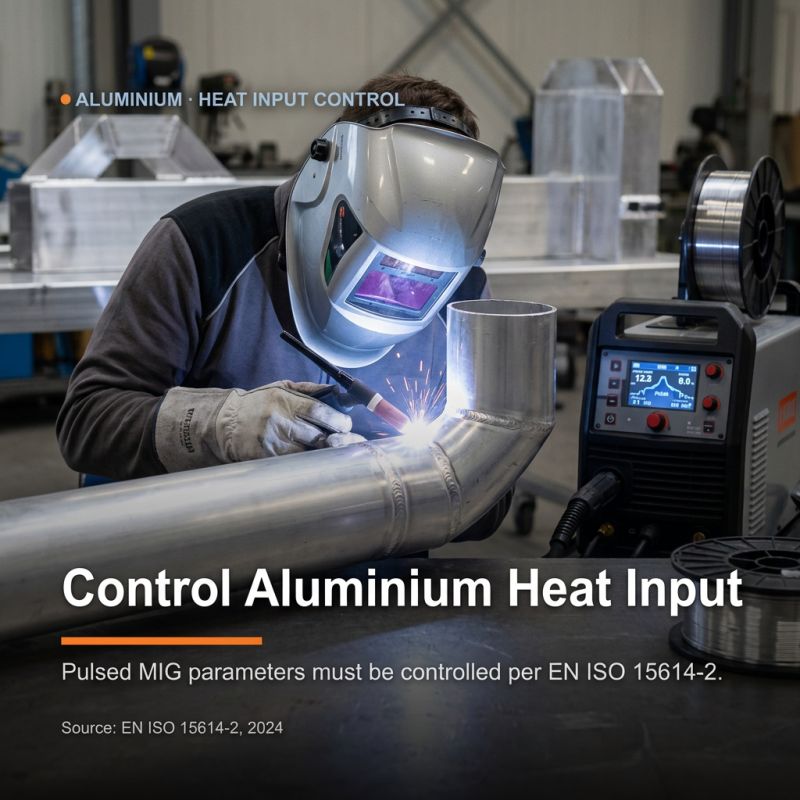
A common issue in production is excessive heat input leading to distortion or loss of mechanical properties in the HAZ. For aluminium alloys like 5083 and 6061, the heat input range is typically between 0.5 and 2.5 kJ/mm, depending on thickness. Exceeding this can cause softening or cracking.
To maintain consistent heat input, welding engineers should:
? Calculate heat input using the formula Q = (U ? I ? 60) / (v ? 1000) for pulsed current, where I is the average current.
? Verify that the pulse parameters are within the qualified range per WPQR.
? Monitor travel speed and wire feed speed closely during production.
Per the standard, any deviation beyond ?15% in heat input requires requalification. This is a key checkpoint during audits.
How do you ensure heat input compliance in your aluminium pulsed MIG applications?
Source: EN ISO 15614-2, 2024