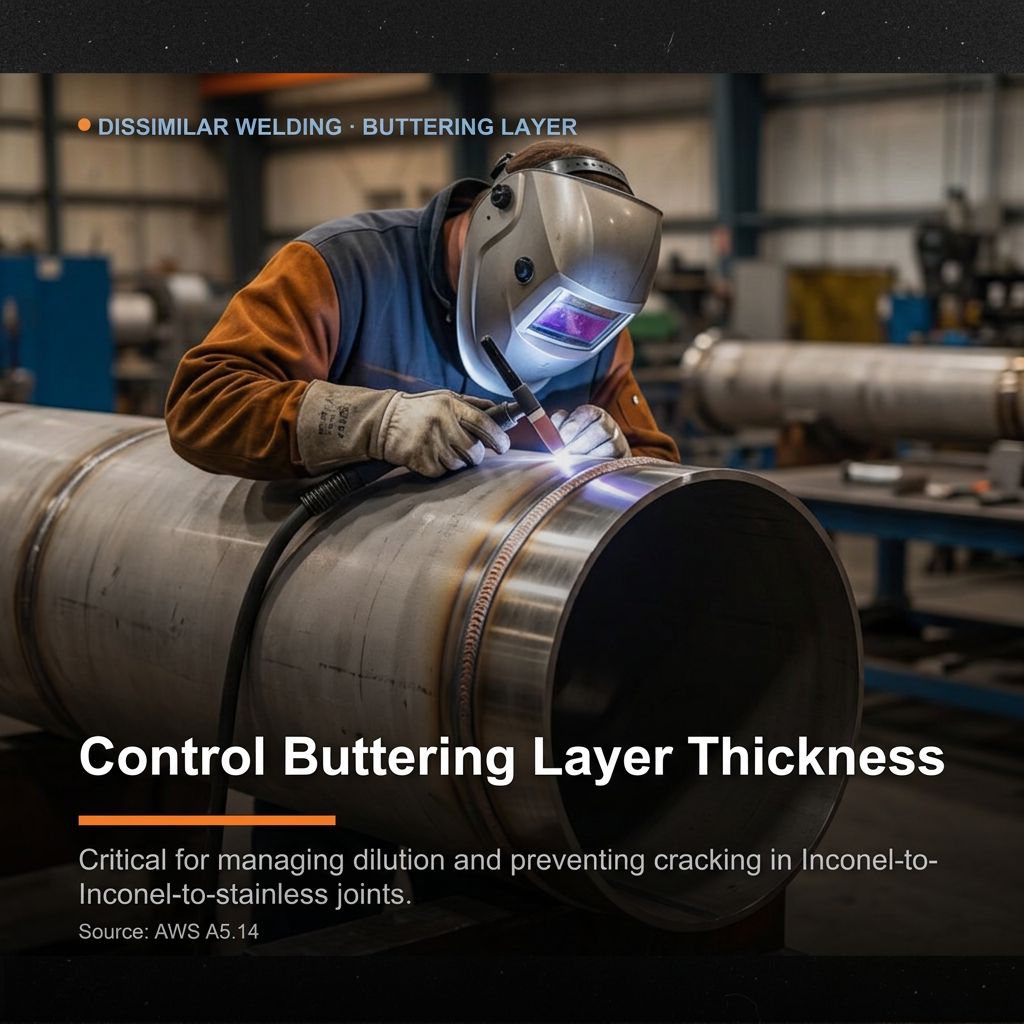
Dissimilar welding between Inconel and stainless steel is common in high-temperature and corrosive environments. A key challenge is managing the dilution zone and preventing cracking. Buttering layers are often applied to the Inconel side before the final weld. The thickness of this buttering layer is critical: too thin and dilution from the stainless steel can cause hot cracking in the Inconel; too thick and it becomes uneconomical and may introduce unnecessary residual stress.
Per AWS A5.14, the recommended minimum thickness for a buttering layer is typically 3 mm to 5 mm, depending on the joint configuration and welding process. This ensures that the final weld metal is deposited on a compositionally stable surface. For pipe butt joints, a thickness of 4 mm is often specified in qualified WPSs. The layer must be deposited with controlled heat input to avoid excessive dilution from the base metal.
Auditors and QC engineers should verify that the buttering layer thickness meets the WPS requirements. A simple gauge or ultrasonic measurement can confirm compliance. In production, maintaining consistent thickness across the joint is essential for repeatable weld quality.
Source: AWS A5.14
What methods do you use to control buttering layer thickness in dissimilar metal welds?