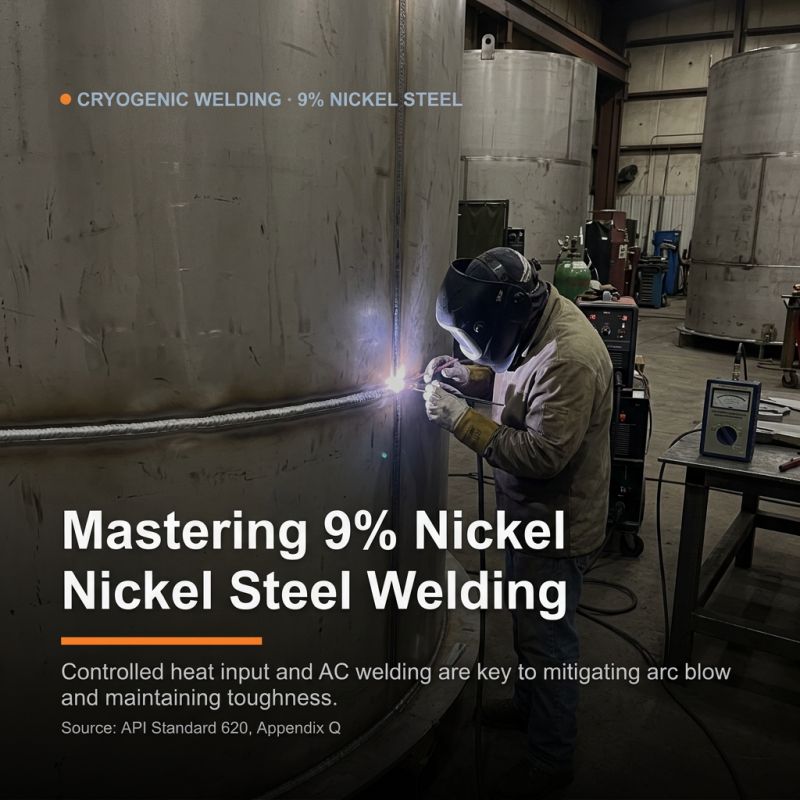
Per API Standard 620, Appendix Q, the welding of 9% nickel steel requires strict control of heat input and interpass temperature to maintain impact properties. Arc blow, caused by magnetic fields interacting with the ferromagnetic material, can destabilize the arc and cause lack of fusion or porosity. Lincoln Electric and ESAB application guides recommend using AC welding or DC with magnetic flux compensation to mitigate arc blow. For GTAW root passes, low-frequency AC or pulsed DC with controlled current ramp reduces arc wander.
Key practices for 9% nickel steel welding include:
? Preheat is generally not required below 50 mm, but interpass must stay below 150?C to avoid embrittlement.
? Filler metal is typically Inconel-type (ERNiCrMo-3 or ENiCrMo-6) to match expansion and avoid carbon migration.
? Post-weld heat treatment is not permitted per API 620, as it can reduce toughness.
? Magnetic permeability of the base metal should be measured; if above 1.02, AC welding is strongly advised.
A TWI Job Knowledge paper on 9% nickel steel confirms that controlled heat input (1.0-2.0 kJ/mm) and stringer bead technique minimize HAZ softening and maintain notch toughness.
How does your fabrication shop handle arc blow on high-nickel or magnetic stainless steels?