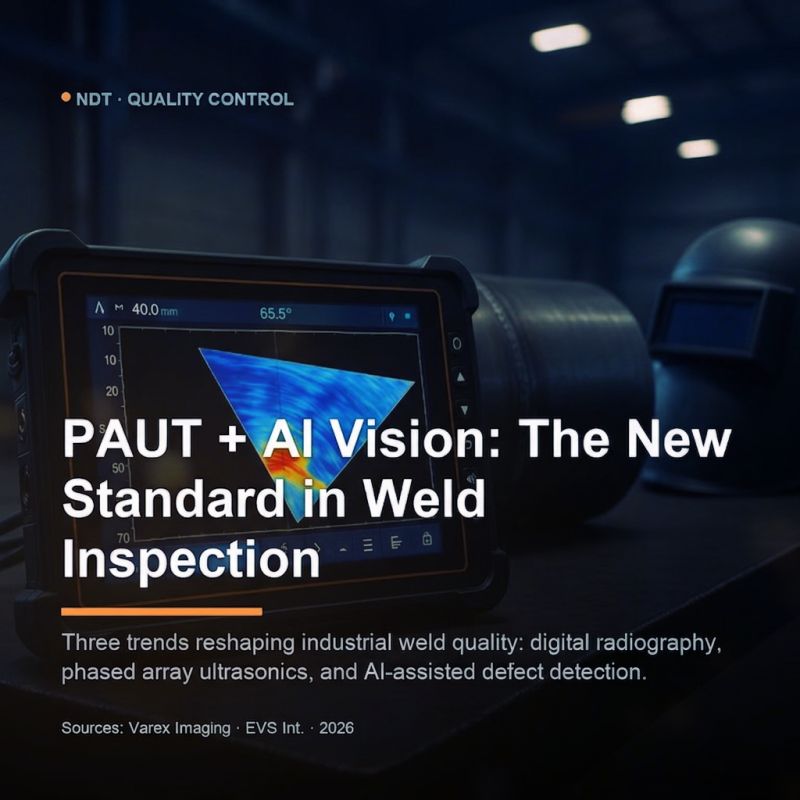
According to a recent Varex Imaging analysis, the NDT industry is undergoing its most significant transformation in decades. The convergence of digitized radiography, phased array ultrasonics (PAUT), and AI-assisted defect detection is reshaping how heavy industries approach weld quality assurance.
Three trends define this shift:
1: From film to fully digital inspection. Computed radiography (CR) and digital radiography (DR) eliminate chemical processing, reduce turnaround time from hours to minutes, and produce images that can be enhanced and shared instantly.
2: PAUT replacing conventional UT as the default volumetric method. A single PAUT probe produces a sectorial (S-scan) image of the entire weld volume in the time conventional UT covers one angle. When combined with TOFD, it achieves high-sensitivity root and tip detection for safety-critical pressure boundaries per ASME Section V and EN 13480.
3: AI vision layered onto robotic welding cells. Machine learning models trained on thousands of radiographic images can identify porosity, lack of fusion, and cracking with consistency that manual review cannot match. Systems now integrate inline process monitoring (arc voltage, current, wire feed) with post-weld PAUT and vision inspection, pushing defect rates from 5-8% (manual) to below 1% in calibrated robotic setups.
The result is a shift from periodic event-based inspection to continuous asset health intelligence. For fabricators serving oil and gas, offshore, pressure vessel, and structural steel sectors, adopting these methods is becoming a competitive necessity rather than an option.
Source: Varex Imaging "What is the future of NDT technology?" (2026) + EVS Int. "Robotic Welding Quality Control" (May 2026)