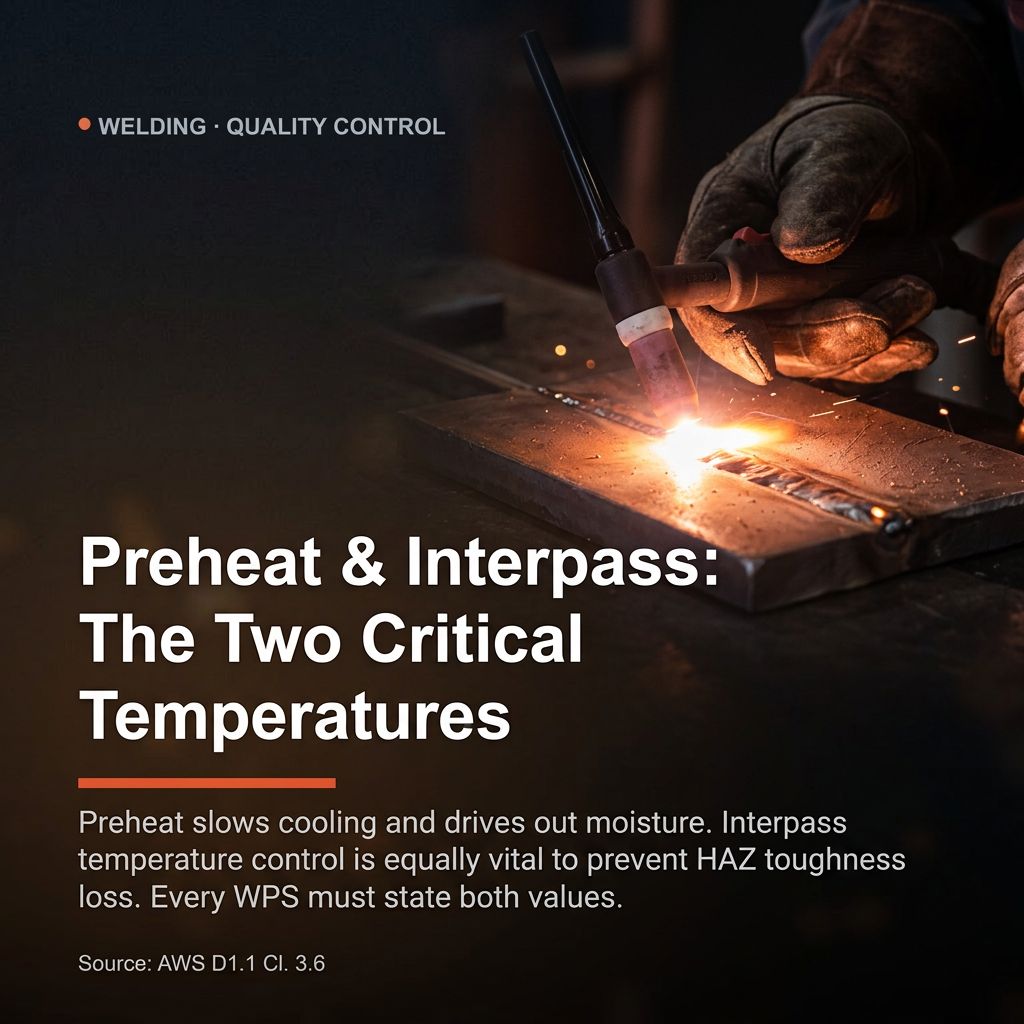
Every welding procedure specifies a minimum preheat temperature. But preheat has two functions that most field inspectors see violated weekly:
**Function 1 — Slowing the cooling rate.**
Preheating of Welds - Why Temperature Alone Is Not Enough
Preheat reduces the thermal gradient between the weld pool and the base material. This slows the cooling rate through the martensite transformation range (800°C to 500°C). For carbon steel above 20 mm thickness, this is the difference between a ductile weld metal and a crack-susceptible HAZ.
**Function 2 — Driving moisture out.**
On-site, preheat evaporates condensation from the joint surfaces before welding starts. This is not theoretical a 1 mm condensate layer at 50°C releases enough hydrogen to push diffusible hydrogen above 10 ml/100g in the first pass. In practice, preheat at 100°C–150°C for 30 minutes is enough to dry the joint before arc strike.
**What most inspectors miss interpass temperature control.**
Preheat is the start. Interpass temperature is the continuation. Many welders hit preheat, strike the arc, and let the interpass drift uncontrolled. If the interpass temperature exceeds 250°C on quenched-and-tempered steels (e.g., ASTM A514), the base metal temper is lost and HAZ toughness drops.
**Field rule:**
- Preheat = minimum temperature at start
- Interpass = maximum temperature between passes
- Preheat + interpass is a band, not a single number
Every WPS should state both values. If the WPS says only "preheat 100°C" and nothing about interpass max, flag it before welding starts.
Sources: AWS D1.1 Cl. 3.6