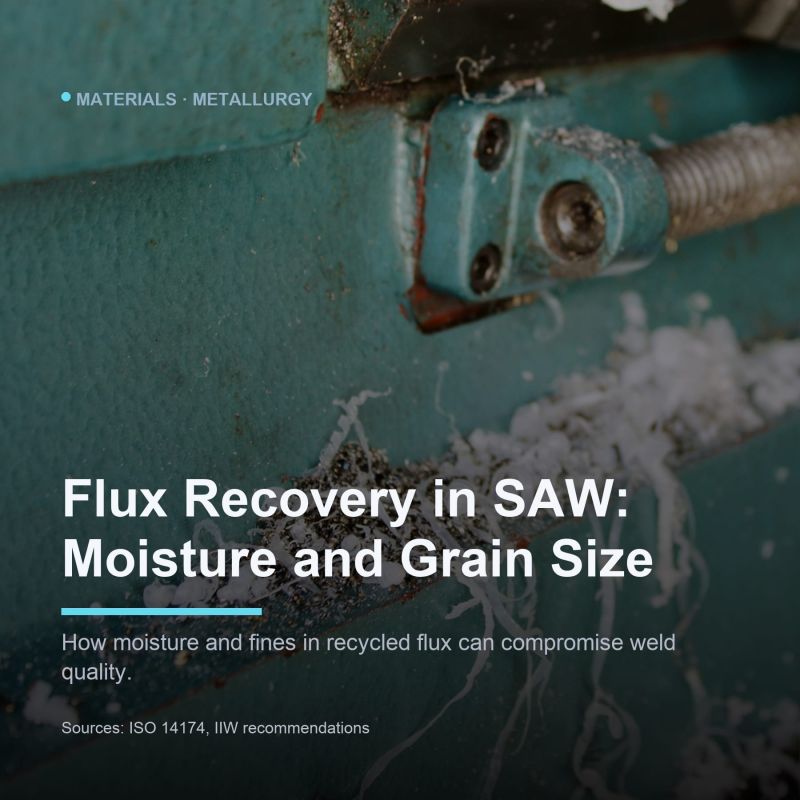
Submerged arc welding (SAW) relies heavily on the flux to protect the weld pool and control the chemical composition of the deposit. One often overlooked factor is the condition of the flux itself. Moisture in the flux can introduce hydrogen into the weld metal, leading to hydrogen-induced cracking. Even small amounts of moisture can be problematic, especially for high-strength steels or thick sections.
Flux recovery systems are common in automated SAW operations, but the recovered flux must be managed carefully. Grain size distribution changes as flux is recycled. Fines accumulate, which can alter the electrical conductivity and arc stability. Most standards, including ISO 14174, classify fluxes by grain size, and the manufacturer's recommended range should be maintained.
A practical approach is to monitor the flux blend regularly. Sieve analysis can confirm that the grain size remains within limits. Moisture content should be checked with a simple loss-on-ignition test. For basic fluxes, which are more hygroscopic, preheating the flux before reuse is often necessary.
The cost of flux is significant, but the cost of a weld failure is much higher. Proper flux management pays for itself.
Source: ISO 14174
How does your shop handle flux recovery and moisture control in automated SAW?